Thursday, March 29, 2012

Will the real Anna...

...please raise your hand?


Woops. She's probably a real Anna, too. Quite possibly an Anna Harder (though almost certainly not Schrock).


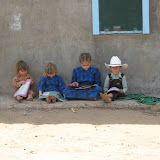
Here we go: Anna, la menonita...


[I just wanted to post that top picture, which my folks took over a year ago in Centro Menno.]

Wednesday, March 28, 2012

Cookies

Our toddler has been asking for cookies alot lately. As in, the requests start rolling in well before breakfast (while we're drinking maté). Rather than saying no all the time, I've started looking for recipes and making somewhat healthier ones. Carrot cookies and Company Muffins from Simply in Season are really quite good. I use yogurt for much of the butter in carrot cookies, which makes them a bit cake-y; they're great straight out of the freezer.

Yesterday I tried a new recipe: Oatmeal Peanut Butter cookies (adapted from here). Bananas and just a bit of honey provide all the sweetness. Well, that and the chocolate chips :)


OATMEAL PEANUT BUTTER COOKIES

2 ripe bananas

1/3 cup peanut butter

2 tbsp 2% milk

1 tsp vanilla extract

2 tbsp agave nectar (I used honey)

1 large egg

2 1/2 cups quick-cooking or rolled oats

1/4 cup whole wheat flour

Handful of chocolate chips

Preheat oven to 350°F. Make banana puree by mashing the bananas with a fork until smooth. Whisk in the peanut butter, milk, vanilla, honey, and egg. Add the remaining ingredients and stir until well combined. Drop dough onto a greased cookie sheet; flatten slightly. Bake 10-15 minutes.


And since we hover at the edges of bobo-ism (minus the income), I have to mention that these cookies are largely local for us: Bananas from the MCC yard (sometimes); peanut butter made by one of our MCC colleagues, probably using Mennonite-grown peanuts; whole wheat flour grown and processed by friends of rural MCCers; eggs and milk (all 2 tablespoons of it) from a former, long-time MCCer's farm, and the honey brought last weekend by our friends, in the Guaraní village of Caipepe. The photo below shows MCC worker Patrocinio Garvizu leading a honey bee workshop in Caipepe last year.


So there you have it. It's actually quite necessary to eat cookies.

p.s. My cookies look nothing like the photo above (maybe because the gas ran out halfway through baking....?)

Saturday, March 24, 2012

Five months


Anna is now five months old! I won't exaggerate and say that time flies...but it is hard to believe she is almost ready to fill out college applications already. Or rather, already reading her way through our board book supply (photo below). We put her into the jumpy-swing this week, and this has been a great way for her to work off some of that abundant energy in her little legs. She can also circle and swing around to see everything that's going on. And, of course, Jonathan can also push her around (causing shrieks of delight).


She has been playing with her feet alot recently, and also reaches to touch people's faces. In general she seems to have become much more content, calmer. She still doesn't usually take more than two half-hour naps all day (which is a bit exhausting for us adults), but she does sleep well at night - and often lays in her bed cooing and kicking (i.e. not crying) after waking up in the morning (between 5 and 6am). And her schedule has become slightly more predictable. The best part of the day for me is bathing her (between 5 and 5.30pm), feeding and singing to her, and then putting her down for night. I also really like that I can take her all over the place in the front carrier, and cook/bake and all those other house-bound things as well. The photo below captures well her interest in the world at large...


Anna is still drinking/eating only breast milk. We haven't weighed or measured her in a few months, but she probably is not in 99th percentile for height or weight (we're aiming more for being on the chart at all). No teeth yet, but lottttts of slobber.

Her most common nickname these days is "B'Anna" - Jonathan's "baby Anna." He also calls her Anita, following the example of our Bolivian co-workers; alternately she is know as "la princesa de CCM."

I've read this in books, experienced it first with Jonathan, and am now re-learning it with Anna: At first you love your baby because s/he is yours, but then you increasingly love him/her because of who s/he is. Such is certainly the case with Anna. What an astounding little girl!


Showing off a little leg in her Old Colony Mennonite dress.

Sunday, March 18, 2012

This and that

1. Anna will be 5 months old on Thursday.

More photos and vital stats at that time. Here she finds her number one sucking finger (at least if Jonathan were to be asked) for the first time.

2. The tub was too small.

We starting bathing Jonathan in a larger tub, and now he stays in there each evening until he looks like a little white raisin. We have to tempt him with reading a Bible story - and then still forcibly pull him out - if there's to be any hope of him going to bed.

3. Jonathan is 5/8 Swiss-Mennonite.

We measured his height on his 2nd birthday and doubled it to authoritatively find out how tall he will be as an adult. Looks like he won't be a giant.

4. Anna has a new friend.

Mary Ann Loewen of Steinbach, Manitoba is here in Santa Cruz for sevaral months, teaching literature at a university in town, among other things. She is a bona fide baby-lover, and has watched baby Anna many an afternoon, for which her mother is exceedingly grateful.

5. Jonathan is Anna's best friend.

He makes her laugh in a way that none of the rest of us can. In fact, a simple smile aimed by him directly at her makes her roar with joy.

Someday she will say "everything I learned before kindergarten I learned from my big brother." Hopefully he won't take it as seriously as my big brother did.

Will they be best friends? Probably not, but for now we're savoring it.

6. Ramont goes to jail.

But only to visit. He, two other MCC colleagues, and Royden Loewen (Mary Ann's husband, who is here writing a book on "horse and buggy Mennonites") went to the Palmasola jail near Santa Cruz last month to visit several Mennonites from Manitoba Colony, who have been incarcerated there since 2009.

7. And I am free!

That is, newly mobile. Before Anna was born, Jonathan and I walked miles and miles around the city every week - doing errends, entertaining ourselves, and getting a bit of exercise. Just last week I finally got brave enough to try taking Anna along. And it worked! She loves seeing the world (it is so much better than taking naps), loves being upright and in motion, and her little neck just doesn't seem to get tired of holding up her wobbly head for block after block. Last week we went and got ice cream one afternoon (effectively negating the exercise bonus), grocery shopping another time, and then again just to sightsee. It's amazing what a huge difference on my life outlook such a little discovery makes.

More new photos in the Jonathan and Anna photo albums to the right.

Thursday, March 15, 2012

Centro Menno


More in the informal series on what we do here in Santa Cruz Bolivia:
The Low German Mennonite Program of MCC Bolivia program has long run a drop-in center called Centro Menno. It is located near the city center, close to the popular market street, "6 de agosto." Centro Menno is well-visited by Bolivian Mennonites of all stripes: anywhere from 50 to 100 people come each of the three days per week that it is open.

Folks come for several reasons. The main draw is to pick up and/or purchase the three MCC publications (Menno Bote, Mennonitische Post, and Das Blatt) for themselves or for their colony store. Another is to purchase books, Bibles, school materials, and maps. In the last several months, daily sales of these items has often been more than $1000. Another big draw is the library. Books in German or English may be checked out for two months at a time. Based on data we keep regarding library use, many Bolivian Mennonites are big readers. Most popular are novels and Russian-Mennonite historical books; biographies, devotional materials, and family-related books are also popular. Centro Menno also provides some help with documentation for Mennonites, but the emphasis is shifting towards training colony representatives to do that for their own people. And a final draw towards Centro Menno is that it is a place to meet other people, visit, drink terere, and just hang out in a familiar place.


Ramont works at the front desk much of the time that Centro Menno is open. Willmar Harder covers it the rest of the time. Probably 98% of the business is done in Low German, 1% in English, and 1% in Spanish. Other staff are Hannah Neufeld (primarily does the finances and book ordering), Kirsten Navis (library and subscriptions superstar), and me. I primarily work on the Menno Bote (see photo below), but on days like today am at the front desk since every other person is away (it's a slow day, though, thus the blog update).


Centro Menno is a fascinating hub of activity, so our jobs provide ample opportunity to visit with a unique people-group. As Ramont says, we'll miss the daily interactions in Low German once we finish our term and return home.

Monday, March 12, 2012

"Cars!" (Happy birthday, Jonathan)


We had a bit of a party for Jonathan's second birthday, on the MCC grounds where we live, with some family, colleagues, and friends. Since he is un poco loco for tractors, I made him a John Deere cake. But the theme ended up being a different kind of vehicle. The nephews had raided their toy boxes and gave their little cousin about 19 different cars, pickups ("buckup"), and trucks ("yuk" or "big car"). The joyous expression "cars!" rang out so many times throughout the afternoon, as the photo below shows:


Plumb tuckered out by the end.

Sunday, March 11, 2012

Two is the new word


Somewhere, recently, Jonathan picked up the word "two." So now instead of just "cars," there are "two cars." Which is fitting, since he turned two last Friday, 9 March. We had a bit of a birthday party on Saturday - more photos to follow. But here are a few snapshots of typical Jonathan at two years old.


Climbing, climbing, exploring, climbing.


Reading. His favorite book by far is Richard Scary's "The Biggest, Best Word Book Ever" (or something like that). Here he's reading during our morning mate-tea time; other good times are morning quiet time in his room and before bed on the floor mattress in his room.


Trains are a new thing (thanks, Clara, for the perfect birthday gift!) and "choo choo" is the sound they make, of course. Here the wash tub and laundry basket stay in train formation while the weary conductor takes a contemplative break.


And bath time. Jonathan loves water, and usually can spend tons of time in the tub (but also goes through phases where he kicks and screams rather than be put in the tub - any ideas?). Recently he learned to turn on his belly and be a fish that way.

It's a fun ride these days for us as parents. How lucky we are (usually)!

Thursday, March 8, 2012

Style Guide

This is one of the best reads around.


I've been purusing it these days (as an "editor," albeit of a German publication, this is part of my job. Well, that might be stretching it just a bit.). Here are a few good reminders for writers, even bloggers:
Do not be hectoring or arrogant. Those who disagree with you are not necessarily stupid or insane. Nobody needs to be described as silly: let your analysis show that he is. When you express opinions, do not simply make assertions. The aim is not just to tell readers what you think, but to persuade them; if you use arguments, reasoning and evidence, you may succeed. Go easy on the oughts and shoulds.

Do not be too pleased with yourself. Don't boast of your own cleverness by telling readers that you correctly predicted something or that you have a scoop. You are more likely to bore or irritate them than to impress them.

Do not be too chatty. Surprise, surprise is more irritating than informative. So is Ho, ho and, in the middle of a sentence, wait for it, etc.

And one of my favorites:

The following letter from a reader may be chastening:

SIR—At times just one sentence in The Economist can give us hours of enjoyment, such as “Yet German diplomats in Belgrade failed to persuade their government that it was wrong to think that the threat of international recognition of Croatia and Slovenia would itself deter Serbia.”

During my many years as a reader of your newspaper, I have distilled two lessons about the use of our language. Firstly, it is usually easier to write a double negative than it is to interpret it. Secondly, unless the description of an event which is considered to be not without consequence includes a double or higher-order negative, then it cannot be disproven that the writer has neglected to eliminate other interpretations of the event which are not satisfactory in light of other possibly not unrelated events which might not have occurred at all.

For these reasons, I have not neglected your timely reminder that I ought not to let my subscription lapse. It certainly cannot be said that I am an unhappy reader.
—WILLARD DUNNING

And finally,
Scrupulous writers will also notice that their copy is edited only lightly and is likely to be used. It may even be read.

-All block quotes taken from
The Economist Style Guide

Tuesday, March 6, 2012

Not for the faint of heart


Nasty boils are making the rounds here in Santa Cruz. Seems like it's a common rainy season affliction, especially for kids. My nephews have them. One of Reuben's popped at school yesterday, and Amos got sent home because of one. Elias has had them in his nose and ears. Hannah goes through about a guaze roll a day covering nasties on Reuben alone (a bit exaggerated, but not so much).

Jonathan has had so many we've lost count - mostly on his face (as seen in this photo from last month), but also on his legs, back, and finger. Besides looking awful, they are really painful (I know this now, because I have one on my ankle). Back in December when he got the first one, we went to the doctor thinking it was a sand fly nest. The doctor prescribed both oral and topical anti-biotics for him. Since then we've just been smearing him with anti-biotic cream and washing his hands more often. Such are the joys of the tropics in summer.

The Vikings jersey was a lucky find in a pile of used clothing on the sidewalk in the Los Pozos market.

Monday, March 5, 2012

Guía de Paz


Guía de Paz is a new drug- and alcohol-rehabilitation center being built near Pailón, Bolivia. What makes it unique is that is will be the only such center in the country geared specifically for Low German-speaking Mennonites. The idea, planning, fund-raising, building, and program-development has and is all being done on local initiative. In fact, nine different colonies, Mennonite conferences, and agencies (including MCC) are working together to make it happen - somewhat unusual in this rather fragmented Bolivian Mennonite context.

As these things tend to go, the building is going up before the program planning has all been completed. The photos above and below show how far built it was last November; now it is almost done. Much of the funding has come from within Bolivia, in part through semi-monthly fundraising meals and auctions. Much of the building has been done by volunteers; some are pictured in the group shot in front of the building. Now the committee is working hard on programmatic aspects such as staffing, methodology, ethical issues, and so on.

This is an important project that MCC Bolivia is privy to (but does not in any way direct). The need for a professional response to drug and alcohol addictions among Mennonites is great. We hope that Guía de Paz will truly guide some of these hurting folks towards a profound peace.


Progress on the center as of November 2011. It is located about an hour east of Santa Cruz.


These are some of the volunteers who helped put up the building. Ramont is sixth from the left in the front row.


Here Ramont says a few works (in Low German!) at a volunteer appreciation event.

[Photos: Willmar T. Harder]

Saturday, March 3, 2012

Nightly battle


Every night Jonathan ends his bath by standing up and making a "tsch tsch" sound. This is his pronouncement that bath time is over, and on to teeth brushing. Every night, given his eagerness to do so, I have new hope that we'll be able to brush without a battle of wills. He wants the child's tooth paste ("yummy!!"). I want to scour his teeth till they shine.

Usually neither of us wins completely, and Ramont has to intervene with an outsider's cool objectivity. Oh, but my patience is in short supply.


But it really isn't so bad either.

Friday, March 2, 2012

What others say


With a new month comes a new issue of the Menno Bote, our in-house MCC publication for Bolivian Mennonites.

One of our goals with this magazine is to include national and international news, since we are the only written source of information for many readers. Included in that news is what others are saying about the Bolivian Mennonites. This month's issue features a feature story run last month by Santa Cruz's main daily newspaper, El Deber. It was a favorable report of the economic life that Mennonites bring to a sector of the Los Pozos market, namely the "famous" (in Mennonite circles here) "6 de agosto" street. Many more blog posts could be (and have been) written about this Mennonite street, so I won't go into details. El Deber ran several good photos, but our MCC colleague Kirsten Navis took some even better ones for the Menno Bote.

(Un)fortunately the Menno Bote is not online, but if you'd like to see more of it, international subscriptions are only $20 now (soon to be $30). Let me know.

Thursday, March 1, 2012

Some muddy roads lead to Charagua


Earlier this week Ramont, together with my brother Willmar and Royden Loewen (Mennonite history professor at University of Winnipeg), traveled to Charagua. The main purpose was to assess the state of MCC water projects in the area, since MCC's fiscal year is coming to a close. The main project this year in Durango Colony was a village well for one of the new villages being carved out of the Chaco. Several years ago the colony purchased land adjacent to the existing colony, mainly to sell to landless, poorer families in 15 hectare chunks. Governmental permission to clear land for yards and some acreage has been very slow in coming. Families are just now starting to inhabit their land, so water for for household and livestock use is very much needed.

The rainy season has slowed many things down - well-drilling and driving, to name just two. The photo below shows the road from Charagua to Durango Colony and beyond to the indigenous Guaraní territory of Isoso. The men made it through, but encountered a vehicle loaded down with supplies and people that wasn't so lucky. They were Bolivians from La Paz, heading towards Isoso on a French-funded project to test livestock blood for the Chagas disease. About an hour was spent trying to pull them out, all to no avail. Such are the hazards of driving in rural Bolivia in February.


Here are the children of Isaak Hildebrand, checking out their own copies of Das Blatt, the MCC German publication especially for kids.


[Photos: Willmar T. Harder]