Thursday, October 2, 2008

Charagua!

This week we visted our new home, Charagua, for the first time. The drive from Santa Cruz takes about 5 hours by truck; the first three hours are on excellent pavement, the last two on curvy, very rough roads through beautiful hilly country -- with mountains closeby on the west. We checked out potential homes in both Charagua town and in Charagua "station," which are about 7 kms apart. The town is slightly larger, while the train stops at the "station," which feels more like a frontier town. The goal is for our house/yard to be our living space, a place for MCC visitors, and house a mini Centro Menno (we also want to have a garden plot, fruit trees, and a tiny pasture for a milk cow, but those are not written as specifically into MCC program plans :) Both towns have beautiful views of the mountains just to the west, small markets with fresh produce, sandy streets, chicken meals sold in almost every doorway -- and an invasion of the Tigo logo (cell phone company). The photo at right is of the Catholic Church in Charagua town; directly across the street from it is a beautiful, new town plaza.

On this trip, we also visited the Mennonite colony of Durango, which we'll be working with most directly. It lies about an hour's drive northeast of Charagua (it doesn't take long to feel completely out of the mountains). There we spent some time at a main gathering site for the colony - general store, parts store, milk gathering place, cheese factory, butchering ring, mill, and probably more - all on one yard. From there we went to a home for a LARGE lunch (noodle soup, chicken, yucca with gravy, deep-fat fried verenike, beans, rice, and bread) with a large family (12 children). In the afternoon we visited a few sites with MCC-sponsored irrigation projects: windmills, pumps, and cisterns. All told, we're quite excited to move to the Chaco and ease into a dual Bolivian/German world...come December.

Friday, September 26, 2008

An even slower life

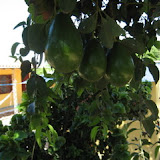
Our life has slowed down so much, it almost seems to have stopped at times. Just a bit of an update: We've been in Spanish language study and living with a host family in Santa Cruz for a month now, and have one week left of this. Our days are pretty much spent in the building you see above. This is the MCC "unit house," which has a few guest rooms, a kitchen in which we make our noon meals most days (and bake snacks for staff refreshments and cook for weekly potluck), two libraries, and is generally the hub of social activity here at MCC. We're lucky enough to have a room with a desk to study and a bed to nap on (even more importantly, of course, it's a cave from which to escape the masses). The house also has a place to hang bunches of green bananas to ripen, cut from trees in MCCers' yards...nothing like guilt-free bananas ;)

This room here -- the "airport library" -- has perhaps been the most important fixture of my (Liz) life here so far. I've been burning my way through several novels each week (in English, unfortunately). So far one can be fairly selective, but I may have to resort to spy and/or "inspirational" romance novels before our time is up.

And on the right, you can see our mailbox...our empty mailbox. We've received mail only once (those much-anticipated Economists are threadbare by now). It's said that mail to Bolivia has often been unreliable, but the current political conflict -- namely blockades between here and La Paz -- has made this worse as well.

I won't presume to update you on the conflict, but if you're interested, one resource is The Democracy Center. The most we experience of it is limited travel outside of the city, sleeping to the sound of firecrackers (and roosters), less fresh produce in the market and at higher prices, limited cooking gas for our host family, a fair amount of anxiety in local people we're getting to know, and no Low German primer that's supposed to come to us by mail. So while we're sometimes amused by how slow our life is, we are so very grateful for how full of peace it also is.

Tuesday, September 9, 2008

To the Colonies

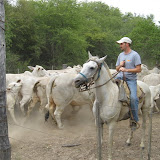
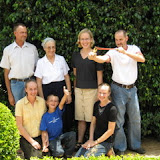
Last Friday we got out to a German Mennonite colony for the first time. We went to the colony of Morganland, about 1.5 hours east of Santa Cruz. My mom (Eva)'s aunt and uncle moved here from Paraguay about 30 years ago with their kids. All but one of them still live in Morganland with their own families (their kids are my second cousins). So on Friday we stopped in first at the Brauns (pictured above), where we had a huge lunch of roasted mutton, salads, and fruit moos. This was followed by a round of terere, men and women separate (the latter looked at photos and discussed family/community social news; the former likely discussed cattle and milk prices).


We also stopped in at the colony store, milk-gathering place, and a few more family homes. At left are my great-aunt and uncle -- my grandma Toews' sister and my grandpa Toews' brother. Their home has seen some large changes recently, namely an indoor toilet, a refrigerator, and lights (electricity came to Morganland just a few months ago); they're also looking to sell their horse-drawn transportation with hopes of getting a car.

Last, we stopped in at the Fehrs (Mrs. Fehr is a daughter of the couple above), whose yard is quite artistically landscaped.

Transportation

A few words about transportation in and around Santa Cruz: it's a lot less crazy than in Bangladesh and way more crazy than in Ukraine. Photos don't quite capture the frequent heart-dropping near-crashes , nor the bus drivers' supreme confidence that their brakes will work absolutely.

Instead, here are two types of transportation: first, a motorcycle-taxi service in Pailon, and second, a German Mennonite taxi on the other side of the same street (we haven't used either type).

Friday, August 29, 2008

Portraits of our new world

Our host family's home is on Marco Polo street. Roosters like this one let us know, without doubt, when it's morning. Each day during breakfast, a man in a pickup truck comes by selling fresh ("raw") milk. Shortly thereafter comes a another man selling the same type of milk from a horse-drawn trailer. If one misses all that action, there's always the little window-shop down the street that sells homogenized milk bags for a bit more.

Homes here tend not to be one discrete building with a yard. Rather, the whole lot is taken up by little buildings connected by tile or cement floors and some roofing. Here you can see the little courtyard right outside our bedroom-building:
and our new live-in friend, Iovanna, "reading" with us.

And finally, the MCC mascot:

Thursday, August 28, 2008

Thus far

It's raining! Quite a change from the dry wind and sun we've become accustomed to here in Santa Cruz. Each day we start out to the tune of "fresh as the morning..."--all nicely showered and Nescafe-d. By noon we're a bit limp (thus the hammocks), and by sundown we're completely slathered in our own sweat and caked with grit.

Our days have settled into a routine: breakfast at our host family's home, 20 minute bus ride to the MCC headquarters in the city center, 1.5 hours of Spanish class for each of us separately, lunch, naps, terare at 3pm in Centro Menno, homework under a thatched roof, exploration of the city, and home for a late supper with any combination of the folks living or visiting our host family.

Tomorrow we'll visit our first Low German Mennonite colony with staff from Centro Menno. Here you can see the building this program is housed in and the rich, carefully attended vegetation around it.


And here you can see Liz' drink of choice thus far:

How we spend much of our time...

so far, anyways...

Monday, August 18, 2008

Hello from Bolivia

We arrived in Santa Cruz, Bolivia on Wednesday morning (August 13), and landed at the MCC compound for several days of local orientation. Bolivia is one of MCC's largest country programs, focusing on peace and justice programming, rural development, urban projects, and Centro Menno (in Santa Cruz) and other work with Low German Mennonites. We'll connect with the last one by working on agricultural irrigation and social work out "in the field" for the first time. But before we can head to Charagua and the Old Colony Mennonite communities around it, we need to learn Spanish (Liz) and Low German (Ramont). So for the next two months we'll be living with Dona Consuelo and taking Spanish lessons here in Santa Cruz...and trying to be patient.

There is much to see and do in Santa Cruz: navigate the market (including a street loaded with German-speaking shoppers), eat lots of meat, ride the crazy, crazy "micros,"
make a fool of ourselves in espanol, and of course, drink terere copiously. The weather has been beautiful (mid 70s today). What a life!

Friday, August 15, 2008

Last time home

Our summer of traveling and visiting ended in Wisconsin. Since Ramont's folks are moving to Virginia and the house is for sale, this was the last time all the Schrocks would be there together.

Besides playing games,


farewell was said to the Ford 8N


and to the church Ramont grew up in and his dad pastored for 36 years,

Exeland Mennonite Church.

Into the woods

2 days in the Wisconsin woods + 0 other people = ahhh...


Trial run for Plautdietsch

At the end of July, we drove north with Liz's mom to visit Toews relatives in southern Manitoba. Many of our married cousins from Paraguay move to Canada for a year or so, when they're in their early 20's, to maintain Canadian citizenship inherited from their grand/parents. We spent time with four of these couples, plus aunts, uncles, and more distant relatives. Most of the visiting was in Low German, i.e. the primary language we'll use for work in Bolivia.

Here Ramont sports his new rrunnerrs at the Forks in Winnipeg.

Tuesday, July 22, 2008

Shenandoah Valley, part II

Grandma Schrock's family - the Grove Weavers - gathered in Harrisonburg this week for a reunion and to visit ancestral landmarks in the Shenandoah Valley.

Here the family explores a cemetary near Weyer's Cave, VA, in which are buried Ramont's great-great grandparents.

Grandma Schrock (far right) and her four living siblings stand behind their grandparent Groves' gravesight.

Shenandoah Valley


This week: Harrisonburg, Virginia.

We're visiting Ramont's brother, Radell - a farmer who sells vegetables and fruit in the local market and through a community-supported agriculture venture.


This gigantic pepper ended up getting stuffed for dinner on Radell's balcony-with-a-view.


Ramont's parents just bought a house in Harrisonburg! We took an informal look at it this morning.


The view at the end of their lane:

MCC Orientation

As will become increasingly clear on this blog, we are preparing for another assignment with Mennonite Central Committee--leaving for the willage of Charagua, Bolivia on August 12 to work with vater and other community/social development issues.


We recently attended two weeks of MCC orientation in Akron, PA, where we discussed issues
of relief, development and peace-making; lived in beautiful willage-inspired rooms; were fattened up with excellent food; met some rather inspiring folks; and discovered that MCC types generally have three children, spaced precisely two years apart.


Saturday, July 12, 2008

Harder Schrocks in the willage

We were in Mountain Lake (MN) the first week of July, visiting with Liz' entire family. David and Rachel moved to Kansas then, leaving us with the folks, Willmar, Hannah, and the three monkeys (Elias, Amos, and Reuben).
Besides eating well and drinking terere copiously, we moved all our possessions into the attic, fished and played croquet tirelessly with Elias,

and even baled some hay.


Harders hit the vater


The Leo and Gladys Harder (Liz' grandparents) family gathered at Shavehead Lake (IN) at the end of June for a weekend of visiting and playing on/in the water. Ramont was the best wake-boarder around (except Uncle Wes), as the first photo shows. The rest of us were happy to fly around and crash together on tubes behind the boat.


Last days at the seminary

At the end of June, we left AMBS for good--both with excitement for what's ahead and with some regret for leaving a good life behind. Here Ramont mows lawn for the last time:


We picked some last (early) produce in the drizzle of our last evening: big red potatoes, onions, sugar peas, basil, cilantro, and four large, beautiful cucumbers.


And it's off to Minnesota (with all our earthly possessions filling about 1/4th of the U-haul)!