Friday, July 24, 2009

A grand family visit!


We've had a pretty crazy (good) month of July, which all started on the 6th. Willmar (Liz's older brother), Hannah, Elias, and Amos arrived in Santa Cruz in the morning, while David (Liz's younger brother) and Rachel arrived a few hours later. We packed them all up into the double-cabin MCC pick-up--Willmar & David in the back--and headed to Charagua that same day (record time for the trip...as in, the longest it's ever taken...).


We were at home in Charagua for about three days--drank lots of terere/mate (here in front of our "centro menno"),

visited our friends in Durango Colony and watched cheese-making,

drove up the river through our mini-mountains,

ate fresh garden/tree produce,

the boys built a house out of all the construction materials on our yard,

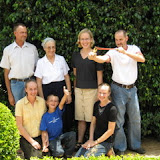
and of course, figured out who is strongest (the smartest are notably absent from the photo).

We returned to Santa Cruz for the MCC Bolivia 50th Anniversary celebrations on Friday and Saturday, and then headed to Morganland Colony to visit the Toews relatives all day Sunday. Monday was spent exploring the city and market, and in the evening David, Rachel, Liz, and Ramont took off on the 23 hour bus for Paraguay (David and Rachel got off in the Chaco to visit more Toews relatives).

It really was a grand time, and we're grateful to have spent the time with close family members.

Sunday, July 5, 2009

Recent sights and so on

We are sitting in Santa Cruz, counting down the minutes until Willmar & Hannah and family touch down tomorrow morning, and then David & Rachel a few hours later. This last month in Charagua has been both rewarding and, as usual, incredibly frustrating. The latter is, as usual, related to the mayhem (construction, etc) on our yard, which just will not end. But good things are happening in our "work" world!

First, the mini resource center on our yard is now open! There are two rooms--one to sell books, maps, and German newspapers and just hang out, and the other is a library with books in German, Spanish and English, as well as a reading/coloring table. It's altogether a bit rustic yet, but people are starting to come in on the two days/week we're open.


Second, we've begun working with a nearby Guarani community to help put up a windmill pump and water tank for their existing (but unused) community well. It's slow going, but this seems to be a good way for MCC to be involved in this area. We also recently toured the large Guarani area of Isoso together with a Belgian NGO worker, who assists women's leadership and artisan groups. Quite eye-opening to look into some very poor-looking homes of what used to be semi-nomadic people. Below is a woman weaving in their traditional style, in her adobe home.


Third, our Mennonite colony work has gotten a bit more focused. At the moment we are finishing a previous project, which provides certain low-income families with well water systems. We've also recently had some positive meetings with the Durango Colony leadership about our plans to promote drip irrigation for gardens and pastures.


And finally, we're becoming better friends with our neighbors (though we're pretty sure they're helping themselves to our chickens' eggs :) and the other gringos living in Charagua--a European NGO worker, a Mennonite missionary couple from Canada, and a whole group of European Jehovah's Witnesses. What a mix it is!

And finally, we're eating lettuce, carrots, onions, and herbs from our garden; tomatoes and peppers are just about ready; and as always, fruits from the trees--papayas just started, avocados and lemons are ending, and figs...well, we're not sure.

Visit to the Kansas cheese factory


It's quite exciting for us when fellow MCCers come to experience our neck of the woods (chaco). We had a great time with the Longeneckers in June, including a trip to a nearby Mennonite cheese factory (the most impressive one we've seen so far). It's a cooperative of 40 families living close together in the "Kansas" area of Pinondi Colony, up and running 2.5 years, and doing quite well.


The cheese is bought by Bolivians who come in cheese trucks and sell it further in Santa Cruz to the north or Yacuiba to the south (selling price is about $2.50/kg and it's sold for about $3.50/kg in the markets).


We got to take several kilos worth of scraps home--those strips cut off to make nice, even blocks of cheese.


Here we are taking orders for the Menno Bote in the Kansas cooperative store and queseria.


Bundled up like babushki for the cold ride home.

Tuesday, May 26, 2009

Scenes from Charagua


Old Colony Mennonites harvesting soya in Pinondi Colony; sorghum heaps in the back.


Harvesting soya with a pull-behind combine (vehicles that are not self-propelled don't need steel wheels), Pinondi Colony.


We bought four hens in the colony. This was the first egg--the only one, so far. Either we can't find the others, or we're missing some crucial ingredient (rooster?!).


The first papaya from the trees on our yard.


Hans Schroeder, our program coordinator, scavenging for avocados on our yard.


Our home.

Construction


Our yard has been taken over (again) by construction workers, at the behest of our overly ambitious landlord. Last week, just when we thought the resource center building was getting "close" to ready, things got a little crazy: roof ripped off, walls knocked out, new doorframes taken down. So now we are getting a kitchen. Another one. Along with a yard full of workers, their kids, dogs, radios, and friends for the foreseeable future. Our patience is running a bit thin these days...

Saturday, April 25, 2009

Visit to Moro Moro


We ventured out of Charagua for the first time last week, returning to Santa Cruz to catch up on MCC business, do a bit of visiting, hit the big city markets, and pack up some of the books for our resource center. We also took a 9-hour bus ride into the mountains to visit our fellow MCC campo workers in Moro Moro. They are helping communities build systems to utelize water from mountain streams, produce honey, improve dairy herds, build dry latrines, and so on. The environment is strikingly different than Charagua, but it was good to also realize some of the overlap in our projects.

Click here to see more photos, including ones of us panting on the 8km hike (mainly) up mountains to visit Liz's second cousin, Nathan Harder.

Monday, April 20, 2009

Settling into a routine


It's now two months that we've been living in Charagua, and we still are so very content here. Photos of some of our activities are in the "Charagua photo album" on the right. On our yard the maralfalfa is about knee high in some places and Ramont laid drip tape just last week. The vegetable garden is growing like crazy: tomatoes, watermelons, carrots, onions and herbs are doing the best. Lemons and avocados are dropping like crazy from the trees on our yard. The rainy season seems to be extending later than usual, which is quite a bonus. The nights are becoming quite cool but the days are usually still hot. We're getting to know people in town, particularly through shopping and going to churches (both Catholic and Evangelical).

In terms of work, we're still in the stage of getting a feel for the context and making initial contacts with potential partners. Recently we went with rural medical staff to give vaccination clinics in Mennonite and Guarani villages (see photos in photo album to the right). This is a good way for us to scope out some of the areas beyond the colonies, particularly their water situation. In the colonies, Liz translated for the Mennonite women--but only in the somewhat rare cases of them coming without their husbands. This is a good way to meet more people, and some have even come to visit us socially at home. The best part of the vaccination clinics, though, is witnessing the sheer terror of toddlers made to step on the weighing scale!

Progress is (very) slowly being made on the building that is to house the resource center (formerly referred to as a mini Centro Menno). It will almost certainly be a few more weeks before we can move books and other literature into it, but we are now in Santa Cruz gathering those materials at MCC. It's fun to be in the city again and to see our MCC friends, but also a bit overwhelming--so many things in the market! so much traffic! so much night light! so much internet access!...

Thursday, March 19, 2009

Visitors


We had our first weekend visitors recently. Hans & Elma Schroeder (our program coordinators) and their kids were the first brave folks from MCC in Santa Cruz to venture down for a few days. It was good to hear the news and otherwise visit, start painting out future resource center, eat outside meals, and go exploring for the "hot springs" (i.e. warm river water) in the mountains just west of Charagua.
Our yard and house is slowly getting even more ideal than it was: cement floor under the shauten dack, pruned fruit trees, garden vegetables and maralfalfa coming up, junk piles being hauled away, and so on. Besides working on that, we make trips to the Mennonite colonies about twice a week to meet people and ask question after question. We have also made plans to help a rural Bolivian clinic with vaccination clinics in Durango Colony. We anticipate that this "partner" will be a good link, as well, to some of the small Bolivian communities surrounding the Mennonite colonies.
Altogether, it is a calm, slow-paced life here in Charagua Station, and we cannot believe how lucky we are to be here! Development, partners, and capacity-building aside, the very best part of the day is making and eating our supper out on the patio, under the stars, and sitting there until it is time to go to bed.
p.s. New photos are posted fairly regularly into the "Charagua Photo Album," which you can click on to the right.

Thursday, February 26, 2009

Home in Charagua!!


We finally made it! Six months into our MCC term, we are now at "home" in Charagua station. We arrived a week ago Wednesday with two vehicle loads of basic furniture, household supplies, and clothes. The house is lovely and the yard is one large paradise (now disguised by piles of building supplies and junk, but that will change). So far we have mainly been working on the house and yard: Ramont built window screens, under-the-door rubber shields, a kitchen shelf, brick sidewalks to the water tap and bathroom, and killed a gigantic tarantula outside our room (while there was still an inch gap under the door and no window screens). Liz has mainly been in bed with dengue fever, but things are looking brighter on that front today. Sevaral times Bolivians or Colony Mennonites have come to our gate to see what is going on and/or when the Centro Menno will open (that will be a few weeks of heavy labor away).


In short, it feels truly good to be here and we look foward to now getting to know some of our neighbors and the Mennonite communities better.

Friday, January 30, 2009

Roadtrip(s) to Charagua

Since we're still not living in Charagua, we've been making the trip there from Santa Cruz weekly. The 280km trip takes about 9 hours by bus or train, 5 hours in a snazzy vehicle, and about 6 hours in "our" Toyota--which we took for the first time this week. The ride is HOT and wind-blown, but this time not too dusty since it recently rained. Here are a few shots from the road:

Here the pavement ends, about 180 kms into the trip. The last 100 kms on bumpy or muddy and winding dirt road can be (or at least seem) a bit daunting...

...but also very beautiful. Cows, donkeys, and goats are the main road blockers, but we also see plenty of pigs, foxes, dragon lizards, and little kids.


Sometimes the road takes us through a river bed,

and sometimes we wish it would.Up close, this bridge looks a bit less than inspiring.


Here is the entrance to Durango Colony, about an hour east of Charagua. The bars across the entrance are to prevent cattle crossings.


Lunch time in Durango; for the Old Colony Mennonites, this means 10.30am. We went gourmet on this day: canned wieners, Menno nacho chips, granola bars, and terere.


A mid-day view of Campo 5, Durango Colony. Much of the colony was at a widow's estate auction. She had recently remarried and so, according to church rules, is required to distribute half of her net financial worth to her children (i.e. half their inheritance).


This is the view going west to Charagua pueblo from Charagua station, a distance of 5 kms. We'll be living in Charagua station, which is slightly smaller of the two.


Heading back to Santa Cruz through another river bed...


...and over another bridge, this time on the highway between Argentina and Santa Cruz.

Monday, January 26, 2009

Snapshots


Here, finally, is a representation of willage vater. This Old Colony Mennonite yard has a "complete set"--well, cistern, and windmill--that MCC has helped provide for low-income families. These two boys live on this yard.


Above is a field of maralfalfa, which Ramont has been checking out as a way to improve dairy herds. Below is field work (using steel wheel tractors) in Pinondi Colony, which borders on the east side of Durango Colony.


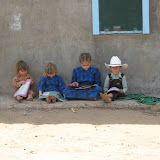
Visiting in Durango Colony last week.


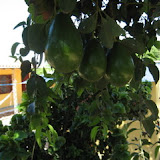
If you look closely, you can see our future dinner under the leaves.

Sunday, January 18, 2009

We're (a wee bit) independent!

We can now drive in Bolivia! Ramont's driver's license has the original name whited-out and his real name typed over it. Liz's lists her purpose in life as "esposa de Ramont"...

We took our very "own" (MCC) pick-up for Charagua out for ride last Sunday, visiting our former host family in Morganland colony. That trip has been immensly simplified and shortened by the opening, just two days earlier, of the Paila Bridge east of Santa Cruz. We whizzed over the Rio Grande in record time and marveled at the modernity of it all. You can see the old bridge off to the left in this photo.