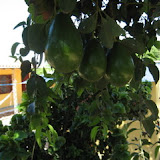
Our future house in Charagua is...still not finished and probably won't be this month. On the upside, now that it's full summer the yard looks like a mini paradise. We noticed the following trees with fruit on them or soon to be:
lemon
lime
avocado (3 gigantic trees)
maracuya
chirimoya
papaya
banana
There are also 8 fairly young citrus trees and a serious grape vine in need of pruning. On the vegetable side of things, we plan to plant our winter garden in early February.
Thursday, January 15, 2009
Sunday, January 4, 2009
Christmas in Chaco, Paraguay
 We just returned from 10 days in Colonia Menno, in the heart of Paraguay's very hot, very dry Chaco. The trip was amazing in many ways. I (Liz) got to probe my grandmother for stories about settling in the Chaco and life thereafter. Thanks to visits with all nine of my mom's siblings who live there--and many more adult cousins--we saw and heard about all kinds of professions: cattle ranching, milking, water hole digging, credit union manager, crop research director, Cooperative commerce administrator, colony slaughter house and milk production workers, nurse, anesthesiologist, hair stylist, satellite TV business owner, computer programmer, caretakers at a home for mentally disabled children, and the list goes on (and on). We were deeply impressed with the Mennonite colonies' political organization and especially the cooperative system. But we also have many more questions than could be answered in ten days!
It was a unique and meaningful way to spend Christmas (four times, with different families each time) and to welcome in the new year. May it go well!

With Oma Toews in Loma Plata. [More photos in the Paraguay 2008 album to the right].
Monday, December 22, 2008
It was a good year:

We're heading off tonight by bus to spend the holidays with the large, extended Toews family in Paraguay.
Merry Christmas to all of you!
Saturday, December 6, 2008
Scenes

Yesterday we went to a Mennonite auction near Pailon. Getting to Pailon requires crossing this bridge -- which can add as much as six hours to a trip, depending mainly on whether impatient drivers clog up the path onto or off the bridge. Our wait yesterday was about an hour.

Loading up the bus for another trip to Charagua last week.

Main street, Charagua Station, Bolivia.

This is what we call "home" these days, across from the MCC complex in Santa Cruz. Not only the bananas are abundant; mangos keep dropping from the sky like hail.
Tuesday, November 25, 2008
Photos
Just a reminder that you can see many more photos by clicking on the "Photo Album" button on the right hand side of this blog. Once you're in our Picasa web album, you can navigate around to see several different sub-albums (though it's still not ideally organized!).
On the road

 We made the trip south to Charagua last week...and realized that we won't be moving there on 1 December as planned. The property MCC plans to rent for our residence and mini Centro Menno is not nearly ready to be occupied yet. The bottom photo shows that the three-room house still has no roof, floor, windows, or plaster siding. A very old building in the yard's center still needs to be demolished. An outdoor bathroom will yet be built. The future Centro Menno building needs a cement floor and repairing. But, all the materials are on hand and work is progressing (if too slowly for our impatience). And seeing the property again reminded us how ideal it seems to be for a garden, testing a super variety of alfalfa, fruit and avocado trees, and much more. We simply can't WAIT to get started! Tomorrow we'll take the bus or train back to Charagua for a few days, in order to begin making contacts in town and further scoping things out. So while many of you will be eating turkey with your families, we'll be eating yet another meal of greasy rice and pollo in a tiny pension with the TVs blaring. Happy Thanksgiving!
Tuesday, November 18, 2008
Morganland
We spent the past five weeks in the German Mennonite colony of Morganland (officially called Canadiensia II), which is 2-3 hours east of Santa Cruz. We lived with the Fehr family, whose two daughters still at home are Liz' second cousins. Ramont spent a portion of each day studying Low German from a book and the rest of the day hearing it straight from the mouth of native speakers. And now...he can understand it fairly well and what he speaks sounds like a native!
Life at the Fehrs was slow-paced, steady, and comfortable. Few words are wasted, yet going visiting in the evenings and on Sunday is expected. Work is more than a livelihood; it seems to border on a hobby (for example, we're always looking to make tasks more efficient so that we can get back to what we "want" to do; here we did tasks slowly and thoroughly because they ARE what we "want" to be doing). A typical day for us went like this:
Ramont helped milk at 6:00; Liz drank mate with the eldest daughter and helped get breakfast ready. Breakfast was anytime between 7:30-8:30. On Mondays and Fridays, Liz helped one of the daughters do laundry from before breakfast until late morning; Saturday mornings were spent cleaning; other mornings held various tasks such as yardwork, visiting, doing the grandparents' laundry, cooking, etc. Ramont would help Peter with whatever he was working on, including field work. Siesta was until 2pm, and scheduled terere breaks were somewhere between 9:30-10:30am and 2:30-3:30pm. Evening chores and milking went from 4:30pm until about 6:15. After that we would drink terere again (or other refreshing drinks!) and have a late supper at 7:30 or so. In the evening we'd often sit outside with just the family, or with visitors, or listen to Low German news on the radio.
We got to visit several different churches in the colony, met most of the Toews relatives, ate copious amounts of heavy farm food (meat, dairy, and carbs), and discussed many a medical condition and details of gory accidents. It was an extremely rich glimpse into one kind of Mennonite colony life.
Here are a few photos:
Now we're back in Santa Cruz for a few weeks, biding our time until we can finally move down to Charagua (around the first of December, we hope...).
Life at the Fehrs was slow-paced, steady, and comfortable. Few words are wasted, yet going visiting in the evenings and on Sunday is expected. Work is more than a livelihood; it seems to border on a hobby (for example, we're always looking to make tasks more efficient so that we can get back to what we "want" to do; here we did tasks slowly and thoroughly because they ARE what we "want" to be doing). A typical day for us went like this:
Ramont helped milk at 6:00; Liz drank mate with the eldest daughter and helped get breakfast ready. Breakfast was anytime between 7:30-8:30. On Mondays and Fridays, Liz helped one of the daughters do laundry from before breakfast until late morning; Saturday mornings were spent cleaning; other mornings held various tasks such as yardwork, visiting, doing the grandparents' laundry, cooking, etc. Ramont would help Peter with whatever he was working on, including field work. Siesta was until 2pm, and scheduled terere breaks were somewhere between 9:30-10:30am and 2:30-3:30pm. Evening chores and milking went from 4:30pm until about 6:15. After that we would drink terere again (or other refreshing drinks!) and have a late supper at 7:30 or so. In the evening we'd often sit outside with just the family, or with visitors, or listen to Low German news on the radio.
We got to visit several different churches in the colony, met most of the Toews relatives, ate copious amounts of heavy farm food (meat, dairy, and carbs), and discussed many a medical condition and details of gory accidents. It was an extremely rich glimpse into one kind of Mennonite colony life.
Here are a few photos:
Now we're back in Santa Cruz for a few weeks, biding our time until we can finally move down to Charagua (around the first of December, we hope...).
Friday, October 10, 2008
MCC Retreat 2008


The entire MCC Bolivia team--roughly 25 national workers and 25 international--met at a Catholic retreat center outside Santa Cruz this Wednesday through Friday. The days were full with workshops, visiting, swimming, napping, eating, and a rather hilarious talent show. It was a very well-planned and organized event, but also had lots of exuberance and creativity...and Spanish.
~~~~~
On Sunday we head out to the Morganland colony to live with a Low German host family for a month. We'll be staying at the Fehr's, whose two daughters still at home are my (Liz') second cousins. Although he'll hear lots of it, Ramont will essentially be teaching himself Low German with a brand new Low German primer, Wi Leahre Plautdietsch (many thanks to Professor McCaffery). It seems like it will also be a good opportunity for us to experience Mennonite colony life, even while this family and colony are far from the most conservative here in Bolivia. At the very least, I hope I can learn to butcher a chicken without flinching.
Monday, October 6, 2008
Colony visit
 Last week turned out to be quite eventful. In addition to the Charagua trip, we spent an afternoon at our Spanish teacher's quinta (in this case, a small dairy farm) near Santa Cruz.
 The next day, Centro Menno staff took us new MCCers [see photo, minus Lynn] to visit a rather wealthy Old Colony Mennonite family in the largest Bolivian Mennonite colony, Riva Palacias. The family has a business making and selling augers and hammer mills; in addition, they own at least one of the colony stores. Below is a colony general store, selling everything from fabric to Catechism books. At bottom is an Old Colony Church in this colony.

Thursday, October 2, 2008
Charagua!
 This week we visted our new home, Charagua, for the first time. The drive from Santa Cruz takes about 5 hours by truck; the first three hours are on excellent pavement, the last two on curvy, very rough roads through beautiful hilly country -- with mountains closeby on the west. We checked out potential homes in both Charagua town and in Charagua "station," which are about 7 kms apart. The town is slightly larger, while the train stops at the "station," which feels more like a frontier town. The goal is for our house/yard to be our living space, a place for MCC visitors, and house a mini Centro Menno (we also want to have a garden plot, fruit trees, and a tiny pasture for a milk cow, but those are not written as specifically into MCC program plans :) Both towns have beautiful views of the mountains just to the west, small markets with fresh produce, sandy streets, chicken meals sold in almost every doorway -- and an invasion of the Tigo logo (cell phone company).
 The photo at right is of the Catholic Church in Charagua town; directly across the street from it is a beautiful, new town plaza.
On this trip, we also visited the Mennonite colony of Durango, which we'll be working with most directly. It lies about an hour's drive northeast of Charagua (it doesn't take long to feel completely out of the mountains). There we spent some time at a main gathering site for the colony - general store, parts store, milk gathering place, cheese factory, butchering ring, mill, and probably more - all on one yard. From there we went to a home for a LARGE lunch (noodle soup, chicken, yucca with gravy, deep-fat fried verenike, beans, rice, and bread) with a large family (12 children). In the afternoon we visited a few sites with MCC-sponsored irrigation projects: windmills, pumps, and cisterns. All told, we're quite excited to move to the Chaco and ease into a dual Bolivian/German world...come December.
Friday, September 26, 2008
An even slower life
 Our life has slowed down so much, it almost seems to have stopped at times. Just a bit of an update: We've been in Spanish language study and living with a host family in Santa Cruz for a month now, and have one week left of this. Our days are pretty much spent in the building you see above. This is the MCC "unit house," which has a few guest rooms, a kitchen in which we make our noon meals most days (and bake snacks for staff refreshments and cook for weekly potluck), two libraries, and is generally the hub of social activity here at MCC. We're lucky enough to have a room with a desk to study and a bed to nap on (even more importantly, of course, it's a cave from which to escape the masses). The house also has a place to hang bunches of green bananas to ripen, cut from trees in MCCers' yards...nothing like guilt-free bananas ;)
 This room here -- the "airport library" -- has perhaps been the most important fixture of my (Liz) life here so far. I've been burning my way through several novels each week (in English, unfortunately). So far one can be fairly selective, but I may have to resort to spy and/or "inspirational" romance novels before our time is up.
 And on the right, you can see our mailbox...our empty mailbox. We've received mail only once (those much-anticipated Economists are threadbare by now). It's said that mail to Bolivia has often been unreliable, but the current political conflict -- namely blockades between here and La Paz -- has made this worse as well.
I won't presume to update you on the conflict, but if you're interested, one resource is The Democracy Center. The most we experience of it is limited travel outside of the city, sleeping to the sound of firecrackers (and roosters), less fresh produce in the market and at higher prices, limited cooking gas for our host family, a fair amount of anxiety in local people we're getting to know, and no Low German primer that's supposed to come to us by mail. So while we're sometimes amused by how slow our life is, we are so very grateful for how full of peace it also is.
Tuesday, September 9, 2008
To the Colonies
 Last Friday we got out to a German Mennonite colony for the first time. We went to the colony of Morganland, about 1.5 hours east of Santa Cruz. My mom (Eva)'s aunt and uncle moved here from Paraguay about 30 years ago with their kids. All but one of them still live in Morganland with their own families (their kids are my second cousins). So on Friday we stopped in first at the Brauns (pictured above), where we had a huge lunch of roasted mutton, salads, and fruit moos. This was followed by a round of terere, men and women separate (the latter looked at photos and discussed family/community social news; the former likely discussed cattle and milk prices).
 We also stopped in at the colony store, milk-gathering place, and a few more family homes. At left are my great-aunt and uncle -- my grandma Toews' sister and my grandpa Toews' brother. Their home has seen some large changes recently, namely an indoor toilet, a refrigerator, and lights (electricity came to Morganland just a few months ago); they're also looking to sell their horse-drawn transportation with hopes of getting a car.
Last, we stopped in at the Fehrs (Mrs. Fehr is a daughter of the couple above), whose yard is quite artistically landscaped.

Transportation
 A few words about transportation in and around Santa Cruz: it's a lot less crazy than in Bangladesh and way more crazy than in Ukraine. Photos don't quite capture the frequent heart-dropping near-crashes , nor the bus drivers' supreme confidence that their brakes will work absolutely.
 Instead, here are two types of transportation: first, a motorcycle-taxi service in Pailon, and second, a German Mennonite taxi on the other side of the same street (we haven't used either type).
Friday, August 29, 2008
Portraits of our new world
 Our host family's home is on Marco Polo street. Roosters like this one let us know, without doubt, when it's morning. Each day during breakfast, a man in a pickup truck comes by selling fresh ("raw") milk. Shortly thereafter comes a another man selling the same type of milk from a horse-drawn trailer. If one misses all that action, there's always the little window-shop down the street that sells homogenized milk bags for a bit more.
Homes here tend not to be one discrete building with a yard. Rather, the whole lot is taken up by little buildings connected by tile or cement floors and some roofing. Here you can see the little courtyard right outside our bedroom-building:
 and our new live-in friend, Iovanna, "reading" with us.
And finally, the MCC mascot:

Thursday, August 28, 2008
Thus far
 It's raining! Quite a change from the dry wind and sun we've become accustomed to here in Santa Cruz. Each day we start out to the tune of "fresh as the morning..."--all nicely showered and Nescafe-d. By noon we're a bit limp (thus the hammocks), and by sundown we're completely slathered in our own sweat and caked with grit.
Our days have settled into a routine: breakfast at our host family's home, 20 minute bus ride to the MCC headquarters in the city center, 1.5 hours of Spanish class for each of us separately, lunch, naps, terare at 3pm in Centro Menno, homework under a thatched roof, exploration of the city, and home for a late supper with any combination of the folks living or visiting our host family.
 Tomorrow we'll visit our first Low German Mennonite colony with staff from Centro Menno. Here you can see the building this program is housed in and the rich, carefully attended vegetation around it.
And here you can see Liz' drink of choice thus far:


Monday, August 18, 2008
Hello from Bolivia
 We arrived in Santa Cruz, Bolivia on Wednesday morning (August 13), and landed at the MCC compound for several days of local orientation. Bolivia is one of MCC's largest country programs, focusing on peace and justice programming, rural development, urban projects, and Centro Menno (in Santa Cruz) and other work with Low German Mennonites. We'll connect with the last one by working on agricultural irrigation and social work out "in the field" for the first time. But before we can head to Charagua and the Old Colony Mennonite communities around it, we need to learn Spanish (Liz) and Low German (Ramont). So for the next two months we'll be living with Dona Consuelo and taking Spanish lessons here in Santa Cruz...and trying to be patient.
 There is much to see and do in Santa Cruz: navigate the market (including a street loaded with German-speaking shoppers), eat lots of meat, ride the crazy, crazy "micros,"
make a fool of ourselves in espanol, and of course, drink terere copiously. The weather has been beautiful (mid 70s today). What a life!
Friday, August 15, 2008
Last time home
 Our summer of traveling and visiting ended in Wisconsin. Since Ramont's folks are moving to Virginia and the house is for sale, this was the last time all the Schrocks would be there together.
Besides playing games,

farewell was said to the Ford 8N

and to the church Ramont grew up in and his dad pastored for 36 years,

Exeland Mennonite Church.


Trial run for Plautdietsch
At the end of July, we drove north with Liz's mom to visit Toews relatives in southern Manitoba. Many of our married cousins from Paraguay move to Canada for a year or so, when they're in their early 20's, to maintain Canadian citizenship inherited from their grand/parents. We spent time with four of these couples, plus aunts, uncles, and more distant relatives. Most of the visiting was in Low German, i.e. the primary language we'll use for work in Bolivia.
 Here Ramont sports his new rrunnerrs at the Forks in Winnipeg.
 Here Ramont sports his new rrunnerrs at the Forks in Winnipeg.